import pyfixest as pf
from pyfixest.report.utils import rename_categoricals

df = pf.get_data()

fit1 = pf.feols("Y ~ X1", data = df)
fit2 = pf.feols("Y ~ X1 + X2", data = df)
fit3 = pf.feols("Y ~ X1 + X2 | f1", data = df)PyFixest 0.70.0
Changelog
TL;DR
- Varying slopes.
| f1[X2]estimates a separate slope onX2for each level off1, infeols(),fepois()andfeglm(). - Formulas are parsed by
formulaic. The fitted model spec is reused forpredict()andfixef(), so new data is encoded exactly like the estimation data, andpredict(newdata=...)now works withi(),poly()and interacted fixed effects. Along with it come new formula spellings:- Fixed-effect interactions are written
f1:f2.
- Fixed-effect interactions are written
- New IV syntax. Instrumental variables are written in brackets,
Y ~ X1 + [X2 ~ Z1], which also accepts interacted endogenous terms such asX2:Z2. The oldY ~ X1 | X2 ~ Z1syntax still works, but it emits a deprecation warning and will be removed in a future release. - New default demeaner. LSMR from the
withinpackage with an adaptive preconditioner. - Typed results. Fitted models expose their state as documented components such as
fit.coeftable,fit.variance_covarianceandfit.model. - Also new: anytime-valid inference (SAVI), Wor‹◊ tables from
etable(), weights and offsets infeglm(), clustering on three or more variables, and Python 3.15. - Many correctness fixes, several of which change results:
ritest()p-values,i()reference levels, weighted RMSE, the IV first stage,decompose()andquantreg’scfm2process. See Bug fixes. - Before you upgrade: pyfixest needs Python 3.11+ and newer formulaic and pandas; model names in multiple estimation changed;
fixef()returns a DataFrame; most private attributes such asfit._seare gone;f1^f2andY ~ X1 | X2 ~ Z1are deprecated. See Breaking changes and Migrating Fitted-Model Attributes.
New Features
Varying Slopes
feols() (including IV), fepois() and feglm() accept slopes that vary by fixed-effect level. f1[X2] absorbs f1 and a slope on X2 for each of its levels; f1[[X2]] absorbs only the slopes. Varying slopes need the default within demeaner, and predict(), fixef(), wildboottest(), ritest(), decompose(), did2s() and CRV3 or HAC inference don’t support them yet (#1929, #1930, #1931, #1999).
pf.feols("Y ~ X1 | f1[X2] + f2", data=df).tidy()| Estimate | Std. Error | t value | Pr(>|t|) | 2.5% | 97.5% | |
|---|---|---|---|---|---|---|
| Coefficient | ||||||
| X1 | -0.927055 | 0.056855 | -16.305595 | 0.0 | -1.038637 | -0.815472 |
Formulas Parsed by formulaic
We no longer split formula strings by hand. Formulas go to formulaic, and the fitted ModelSpec is reused to build model matrices for predict() and fixef(). This removes a class of bugs where new data was encoded differently from the estimation data. Most terms now follow formulaic’s syntax (#1362, #1437).
predict(newdata=...)works withi(),poly()and interacted fixed effects. Unseen levels predictNaN.- Fixed-effect interactions are written
f1:f2. sw(),csw(),sw0()andcsw0()accept a single argument, so| sw0(f1)fits models with and withoutf1(#1830).
The old spellings still work with a deprecation warning and will be removed in a future release. The behaviour changes that come with the new parser are listed under Breaking changes.
New IV Syntax
Instrumental variables are written as a bracketed block in the main formula, Y ~ X1 + [X2 ~ Z1], combined with fixed effects as Y ~ X1 + [X2 ~ Z1] | f1 (#1362). The block accepts interacted endogenous terms such as X2:Z2 (#1890), and the main formula sets the intercept of both stages (#1998).
The old Y ~ X1 | X2 ~ Z1 syntax still works, but it emits a deprecation warning and will be removed in a future release.
within LSMR Is the Default Demeaner
The default demeaner is now LSMR from the within Python package (within-py, a new required dependency), replacing the Rust crate compiled into pyfixest. Rust MAP is still available through MapDemeaner().
The default preconditioner="auto" now selects within’s adaptive preconditioner. It starts with a cheap diagonal preconditioner and builds additive Schwarz only when convergence stalls, which skips Schwarz’s setup cost on well-connected fixed effects where it rarely pays off. fepois() and feglm() still reuse the preconditioner across IRLS iterations (#1920, #1922, #1923).
Typed Fitted-Model State
Fitted models expose what they computed as documented components instead of private attributes (#1533, #2028):
| Component | Contents |
|---|---|
fit.model |
formula, dependent variable, fixed effects, estimator, sample split |
fit.options |
estimation options: ssc, weights, demeaner, storage settings |
fit.sample_info |
number of observations and dropped rows by reason |
fit.coeftable |
estimates, standard errors, t-statistics, p-values, confidence intervals |
fit.variance_covariance |
covariance matrix, small-sample corrections, cluster counts |
fit.sandwich |
scores, Hessian and bread |
fit.fitstat |
RMSE, R² measures, deviance, log-likelihoods |
fit.fitted_values |
in-sample predictions on the link and response scale |
fit.collinearity |
columns dropped as collinear |
fit.fixef_counts, fit.fixef_estimates |
fixed-effect level counts; fixed-effect estimates after fixef() |
fit.first_stage |
IV first stage and its diagnostics |
fit.wald |
joint Wald test from fitting, replaced by each wald_test() call |
fit.capabilities |
inference and post-estimation methods the model supports |
fit.solution |
quantile-regression solver state |
The components that describe the model and its sample survive store_data=False and lean=True.
Safe Anytime-Valid Inference (SAVI)
evalue(), pvalue_savi() and confint(inference_type="savi") return e-values, sequential p-values and confidence sequences for linear regression, following Lindon et al. (2026) (#1386).
fit = pf.feols("Y ~ X1 + X2", data=df, vcov="iid")
fit.confint(inference_type="savi")| 2.5% | 97.5% | |
|---|---|---|
| Intercept | 0.498124 | 1.279434 |
| X1 | -1.288812 | -0.697059 |
| X2 | -0.254767 | -0.097918 |
Smaller Additions
etable(type="docx")returns or saves editable Word tables, styled throughdocx_style(#1541).feglm()acceptsweights,weights_type,offsetandfamily="poisson". Offsets can be expressions such asoffset="log(exposure)"(#1349, #1458).fepois()converges faster thanks to step-halving and warm starts (#1347).- Cluster-robust inference accepts three or more cluster variables, e.g.
vcov={"CRV1": "firm + year + region"}(#1599). tidy(),confint()andsummary()gain aninference_typeargument.confint(inference_type="simult")replacesconfint(joint=True)(#1398).- Python 3.15 is supported. On 3.15, plots use matplotlib because
lets-plothas no compatible release yet (#2030).
Breaking Changes
Requirements
Formulas and Model Names
- Model names in multiple estimation are canonical formulas.
"Y ~ sw(X2+X1, X1)"now names its models"Y ~ 1 + X2 + X1"and"Y ~ 1 + X1". Updaterename_modelsmappings and lookups intoall_fitted_models. Expansions that produce the same model twice estimate it once and warn (#1362, #1873, #1890). fixef()returns a DataFrame with columnsvariable,code,levelandcoefficientinstead of a nested dict. With two or more fixed effects, the reference levels of the second and later ones are listed with coefficient 0 (#1362).- The main formula sets the intercept for both IV stages; a
0or1inside the IV block is ignored (#1998). - Fixed effects must be data columns, or
:interactions of them, whose names are valid Python identifiers. Transforms andobject-dtype columns are rejected, andpredict()requires the same dtype as at fit time (#1898, #1902). log()in formulas is nownp.log. Zeros are counted as infinite rather than missing, and numpy warns on zero or negative inputs. Estimates are unchanged (#1806, #1869).- Some malformed formulas raise
formulaic.errors.FormulaSyntaxError, which is unrelated topyfixest.errors.FormulaSyntaxError; catch both (#1362). factor_interactionmoved topyfixest.estimation.formula.transforms.factor_interaction(#1362).
Fitted Models and Post-Estimation
- Most private attributes from 0.60 are removed. Accessing one, e.g.
fit._se, raises anAttributeErrorthat points to the migration guide; usefit.coeftable.seinstead. Names used by released versions of marginaleffects and maketables keep working, and the IV attributes_model_1st_stage,_f_stat_1st_stageand_eff_Fkeep working with a deprecation warning. See Migrating Fitted-Model Attributes (#2028). pf.ssc()returns a frozenSscinstead of a dict (dicts are still accepted as input).pf.get_ssc()takes anSscandDegreesOfFreedomCountsand returns aSmallSampleCorrection.wald_test()returns aWaldTestinstead of a Series (#1595, #1591).feglm().resid()returns response residualsy - muby default; the old working residuals areresid(type="working")(#1349).feglm(family="gaussian")now reproducesfeols()exactly, including its small-sample correction (#1352).- Passing
datatovcov()raisesValueError. It silently misaligned rows in cluster-robust standard errors (#1825, #1956). vcovandvcov_kwargsare checked before fitting, so a misspelled estimator or a missing cluster column fails early withValueError(#1577).- Several methods that ran on unsupported models and returned wrong numbers now raise:
ccv()on weighted models;Feols.update()withinplace=True, weights or IV; CRV3 on non-Poisson GLMs;ritest()on models other than OLS and Poisson;wildboottest()on IV and non-OLS models;decompose()on non-feolsmodels or with multiway clustering;predict(),wildboottest(),ccv(),decompose()andvcov()updates ondid2s()fits; andpredict(se_fit=True)for GLMs and quantile regression (#1516, #1620, #1726, #1698, #1652, #1983). - Invalid arguments to
ccv(),ritest(),event_study(),did2s()andlpdid()raiseValueErrororTypeErrorinstead ofAssertionError. Every warning now has an explicit category and points at your code rather than pyfixest internals (#1723). - Methods that need data removed by
store_data=Falseorlean=TrueraiseMissingModelDataError(#1540). - pyfixest no longer uses or reseeds NumPy’s global random generator. Data from
get_blw(),get_sharkfin()andget_panel_dgp_stagg()changes, andccv()and simultaneous confidence intervals needseed=to be reproducible (#1705). - The model classes take
options=andsample_split=constructor arguments instead of many loose keyword arguments (#1598, #1719). did2s()rejects a second stage without an intercept, IV formulas and multiple estimation (#1918).
Demeaner
preconditioner="auto"now means adaptive, so results can differ slightly from 0.60. Passpreconditioner="additive"for the old behaviour (#1922).pf.Preconditioneriswithin.Preconditioner. Itsvariantis replaced byconfig, andbuild_time_secondsis renamedbuild_duration_seconds. Preconditioners pickled with older versions can’t be loaded (#1920).
Deprecated
These still work and emit a warning (#1362, #1437, #1398, #1704, #2028):
Y ~ X1 | f1^f2: writeY ~ X1 | f1:f2.Y ~ X1 | X2 ~ Z1: writeY ~ X1 + [X2 ~ Z1].Y + Y2 ~ X1: writesw(Y, Y2) ~ X1.confint(joint=True): useconfint(inference_type="simult").FixestMulti.FixestFormulaDict: usefit.model.parsed_formula.fit.get_performance(): usefit.fitstat.fit.n_separation_na: usefit.sample_info.maxiter,tolandseparation_checkon GLM fits: usefit.options.
Removed
- The
demeaner_backend,fixef_tolandfixef_maxiterarguments; use theDemeanerAPI from 0.60 (#1332). - The JAX demeaner and solver, and the SciPy and CuPy LSMR backends. On GPU, use
LsmrDemeaner(backend="torch", device="cuda")(#1333, #1334, #1718). FeolsCompressed(#1336) andpf.dtable(); usemaketables.DTable()instead (#1404).- The
fit.FixestFormulaattribute (usefit.model) and the callableFeiv.first_stage();fit.first_stageis now a component (#1610, #1588). FixestFormulaParser,model_matrix_fixest(), thepyfixest.estimation.feols_,feiv_andfepois_modules (importFeols,FeivandFepoisfrompyfixest.estimationinstead), and several unused helpers inpyfixest.utils(#1607, #1704).
Bug Fixes
Inference
ritest()now permutes the observed treatment. It used to draw treatments uniformly from the distinct values, which changed the share treated and typically made p-values too small. This also affectsrwolf()andwyoung()withsampling_method="ri". Withcluster=, a treatment that varies within a cluster raisesValueError(#1964, #1965).ritest(type="randomization-t"),ritest(cluster=...)andccv()keep the fitted model’s covariance estimator and small-sample corrections, and the randomization t-statistic is centred at the null (#1986–#1989).ritest()rebuilds treatment-dependent interactions on every draw (#1979), and its fast algorithm works with interacted fixed effects (#1780, #1866).vcov({"CRV3": ...}),ritest()andccv()refit with all the original estimation options. Before, a Poissonoffsetand options such ascontextordrop_interceptwere dropped (#1709, #1711).- CRV3 on
event_study()fits refits withfeols()instead of Poisson (#1619). wildboottest()anddecompose()leave out covariates that the fit dropped as collinear (#1778, #1867), andwildboottest()requiresparaminstead of returning p = 0 (#1959, #1969).confint()withkeepordropcould attach intervals to the wrong coefficients (#1397).- The RMSE of weighted fits divides by the sum of weights (#1883, #1884).
IV
- The first stage uses the second stage’s sample, options and full covariance estimator. Before, two-way clustering fell back to one-way clustering, and
vcov="NW"or"DK"failed (#1710). - Redundant instruments no longer change the first-stage F or effective F (#1996). Instruments that don’t identify an endogenous variable raise
IVIdentificationError(#1891, #1992, #1993). - Covariates named like generated values (
X2_hat), misplaced IV blocks, and|inside IV expressions are handled correctly (#1736, #1766, #1890, #1834).
Formulas
- Multiple estimation no longer reuses demeaned values from a different expression that happens to have the same column name (#1762, #1914).
i()fixes:- a boolean second variable fits one slope per level (#1756, #1907);
- levels come from the data before missing rows are dropped, and unused categories of a
Categoricalare ignored, which fixes the reference level in some models (#1769, #1912); - without an intercept, every interaction cell is kept (#1767, #1942);
C(k)marks a numeric second variable as a factor, soi(a, C(k))interacts two factors instead of fitting slopes.ref2andbin2no longer turn a numeric second variable into a factor and raise instead (#1770, #1804, #1943);binis validated (#1771, #1945);- factor-by-factor interactions work with NumPy 1.25 (#1909, #1952).
- Formulas whose terms produce duplicate column names raise instead of keeping only the last column (#1928, #1947).
sw()and friends work across several lines and with a space before the parenthesis (#1810, #1847). Stepwise terms keep their grouping under:,*and-(#1828).log()accepts nullableFloat64andInt64columns (#1807, #1829).weights=accepts column names with spaces or operators (#1815, #1844). Zero weights are dropped with a warning instead of raising (#1800, #1864).
GLM and Poisson
- Frequency weights work in
fepois()andfeglm()(#1521). - Separation checks: Gaussian
feglm()no longer drops groups as separated (#1978, #1982); logit and probit also drop groups whose outcomes are all 1, and ignoreseparation_check=["ir"]with a warning (#1623, #1982); the iterative-rectifier check keeps rows aligned after missing values and respects the formula context and demeaner (#1777, #1799, #1846, #1841, #1877, #1454). fixef()andpredict()for fixed-effects-only GLMs work on the link scale instead of the response scale (#1622).fepois(context=0)finds functions defined in your code (#1656, #1835).fixef(),predict(),decompose()and the LSQR solver raiseNonConvergenceErrorinstead of returning unconverged estimates (#2009, #2012).
DiD and Decomposition
did2s()standard errors use the first-stage fixed-effect encoding, handle collinear second-stage columns, and reject missing cluster IDs or fewer than two clusters (#1758, #1811, #1812, #1918, #1865, #1980). It also explains which first-stage fixed effects can’t be estimated (#1244, #1368).event_study(estimator="saturated")uses thexfmlcovariates, which it used to ignore (#1966, #1975).decompose()no longer depends on the order of regressors (#1967, #1974), keeps mediators left out ofcombine_covariatesin anOthergroup (#1962, #1972), and draws independent bootstrap samples in parallel, soseedgives the same result for anynthreads(#1696).
Other
quantreg(multi_method="cfm2")uses the density-weighted Hessian. Before, the updates mostly shifted the intercept (#1745, #1842).LsmrDemeaner(backend="torch")raisesImportErrorwhen PyTorch is missing instead of silently using MAP (#1718).iplot()no longer mistakes regressors with::in their name fori()terms (#1564).- Fitting models no longer imports Matplotlib, Seaborn or Lets-Plot; they load only when you plot (#1483).
Documentation
- Tutorials, the README and docstrings use the new formula spellings, and the formula tutorial maps each deprecated form to its replacement (#1836).
Contributor Workflow
- New pixi tasks:
bench-estimationfor before/after timing,test-r-fixest-fastfor a quick comparison with R, andtest-release-contractfor a comparison with pyfixest 0.60.0 (#1732, #1476, #1495). - Only the default demeaner is tested against
fixestin the main test suite; the other backends run in a separate workflow (#1485). - Repository-local skills and developer guides for contributors and coding agents (#1476).
pixi.lockuses the v7 format, which needs pixi 0.71.0 or newer (#1498).- Internals: fitted models keep the formula
ModelMatrix, the demeaning cache hands out read-onlyfloat64arrays, and weighting happens inside the solver instead of on stored arrays (#1499, #1516, #1520).
PyFixest 0.60.0
This release focuses on the fixed-effects demeaning stack. The main changes are a typed demeaner API, switching from numba to Rust for the default MAP demeaning algorithm, reusable within preconditioners, PyTorch-backed LSMR demeaning on CPU and GPU, and a few deprecations for older backend options. It also adds fepois() offsets, Typst output for etable(), and several panelview() fixes.
Rust MAP Default and Optional Numba
MapDemeaner() now defaults to backend="rust". The Numba MAP backend remains available via MapDemeaner(backend="numba"), and the fast randomization-inference path (fit.ritest(..., choose_algorithm="fast")) still uses Numba. Numba is now an optional dependency installed with pip install pyfixest[numba].
Typed Demeaner API
A new typed demeaner API replaces the old demeaner_backend, fixef_tol, and fixef_maxiter arguments to feols(), fepois(), and related functions. Instead of passing a set of loosely related keyword arguments, you can now pass a configuration object that makes the chosen algorithm, tolerance, iteration limit, and device explicit.
import pyfixest as pf
from pyfixest.demeaners import MapDemeaner, LsmrDemeaner

# Old API (deprecated)
fit = pf.feols("Y ~ X1 | f1", data=df, demeaner_backend="rust", fixef_tol=1e-8, fixef_maxiter=5000)

# New API
fit = pf.feols("Y ~ X1 | f1", data=df, demeaner=MapDemeaner(backend="rust", fixef_tol=1e-8, fixef_maxiter=5000))
fit = pf.feols("Y ~ X1 | f1", data=df, demeaner=LsmrDemeaner(backend="within", fixef_atol=1e-8, fixef_btol=1e-8, fixef_maxiter=5000))
fit = pf.feols("Y ~ X1 | f1", data=df, demeaner=LsmrDemeaner(backend="torch", device="cuda"))
Deprecations: The demeaner_backend, fixef_tol, and fixef_maxiter arguments to feols() and related functions are deprecated and will be removed in a future release. The _fixef_tol and _fixef_maxiter attributes on fitted model objects are removed; going forward, this information is collected from the typed fit.options.demeaner via fit.options.demeaner.fixef_tol and fit.options.demeaner.fixef_maxiter.
Default change: LsmrDemeaner() now defaults to fixef_maxiter=1_000 (previously inherited 10_000 from BaseDemeaner). LSMR typically converges in far fewer than 1,000 iterations, but if you hit "Demeaning failed after 1000 iterations" on a difficult problem, pass LsmrDemeaner(fixef_maxiter=10_000) (or higher) explicitly.
The lower-level pyfixest.core.demean.demean_within(...) helper also tightened its default tol from 1e-6 to 1e-8. Calls through LsmrDemeaner already pass max(fixef_atol, fixef_btol) (default 1e-8), so the new default matches what the typed API was already using. Only direct callers of demean_within(...) with no tol argument see a behaviour change.
Diagonal Preconditioner for the within LSMR Backend
PyFixest now bundles version 0.2.0 of the within Rust solver, which adds a diagonal (Jacobi) preconditioner. You can use it with LsmrDemeaner(backend="within", preconditioner="diagonal"), alongside the existing "additive" (default) and "off" options.
Reusing Preconditioners
The within LSMR backend now exposes its additive Schwarz preconditioner so the (potentially) expensive setup phase can be amortised when users explicitly reuse it across regressions based on the same fixed-effect design.
import pyfixest as pf
from pyfixest.demeaners import LsmrDemeaner

df = pf.get_data()

# Every Feols-family fit exposes the preconditioner that was used.
fit = pf.feols("Y ~ X1 | f1 + f2", data=df, demeaner=LsmrDemeaner())
pre = fit.preconditioner

# Pass it back via `LsmrDemeaner(preconditioner=...)` to skip the setup
# phase on a later fit over the same design.
fit_fast = pf.feols(
    "Y ~ X1 + X2 | f1 + f2",
    data=df,
    demeaner=LsmrDemeaner(preconditioner=pre),
)
For fepois() and feglm(), the first IWLS iteration builds the preconditioner and every subsequent iteration reuses it under the changing working weights. That means the reused preconditioner is “stale” because it was built under the initial iteration’s weights. LSMR still converges to the correct demeaned values, but it may take a few extra iterations per IWLS step. The setup phase is paid once instead of once per IWLS iteration.
Each Preconditioner also reports its original setup time via preconditioner.build_time_seconds, which can be useful when profiling large fixed-effect problems. Preconditioner instances are pickleable, so the setup phase can also be amortised across Python sessions. See Choosing a Demeaner Backend for details.
PyTorch LSMR Backend
PyFixest now includes an experimental PyTorch-backed LSMR demeaner. It supports CPU execution, CUDA GPUs, and Apple Silicon MPS:
fit = pf.feols(
    "Y ~ X1 | f1 + f2",
    data=df,
    demeaner=pf.LsmrDemeaner(backend="torch", device="cuda"),
)
Install the optional dependency with pip install pyfixest[torch]. For CUDA, you may need to install a CUDA-enabled PyTorch build separately, following the PyTorch installation instructions.
JAX, CuPy, and SciPy Backend Deprecations
The jax MAP demeaner backend, the cupy / scipy LSMR demeaner backends, and the solver="jax" OLS solver option are deprecated and will be removed in a future release. Passing any of them now raises a DeprecationWarning.
We recommend the following replacements:
- JAX MAP on CPU →
MapDemeaner()(the default rust MAP). - JAX MAP on GPU or
LsmrDemeaner(backend="cupy", device="cuda")→LsmrDemeaner(backend="torch", device="cuda"). - Scipy or Cupy LSMR on CPU →
LsmrDemeaner()(the defaultwithinbackend).
Regression Compression Deprecation
The use_compression argument to feols() is deprecated and no longer supported. This feature implemented the in-memory regression compression approach from Wong et al. (2021) via a Mundlak/sufficient-statistics transform, and the implementation has now been removed. For large-dataset use cases, the duckreg package provides a more general out-of-memory solution. See #1302 for context.
Passing use_compression=True now raises a NotImplementedError.
Offsets in fepois()
pf.fepois() now supports offsets via the new offset argument. This is useful for Poisson models with an exposure term, such as offset="log_population". Thanks to @bradhackinen and @marie-gar for the contribution.
etable() Typst Output and Formatting
pf.etable() now supports type="typst" output. Its default coef_fmt is also inherited from maketables, which keeps PyFixest closer to the table engine it uses internally. As before, significance stars are controlled by the coefficient format string: include * on a statistic token, for example b:.3f*, when you want stars in the rendered table.
panelview Bug Fixes
- Validates that the
treatcolumn is binary ({0, 1, True, False}) and normalizes it to boolean before plotting, matching R’spanelViewbehavior. See #1311. - Fixes
sort_by_timingto sort units by the period of first treatment (viaargmax) rather than by the total number of treated periods. - Raises an explicit
ValueErrorwhen thetreatcolumn contains missing values instead of silently dropping them. - Fixes a latent bug in
_plot_panelviewwhere passing a user-suppliedaxtogether withlegend=Truereferenced an unbound figure variable; the colorbar is now attached viaax.figure.
PyFixest 0.50.1
Bug Fixes
- Fixes an import-time failure on Python 3.13 in some environments where a
narwhalstyping alias was exposed as a string at runtime. This could cause imports offeols()/feglm()to fail before any model code ran. See #1263 for details. - Clarifies
pf.etable()significance-star behavior after the migration tomaketables: stars are rendered only whencoef_fmtincludes*on a statistic token, for exampleb*orb:.3f*.
PyFixest 0.50.0
Tip
You can install the latest pre-release to try out the new features:
pip install pyfixest==0.50.0a2
pip install --pre pyfixest
New Demeaner Backend via the within package
We recently came together for a PyFixest sprint with the team from AppliedAI, and one new feature that already made it’s way into the code base is a new typed demeaner configuration that performs really well for sparse fixed effects structures.
The new solver is exposed via pf.LsmrDemeaner(backend="within") and is a significant performance improvement for sparse fixed effects structures - such as matched employer-employee data, patient-doctor panels, or trade networks - where the standard MAP algorithm might struggle. On well-connected graphs, pf.MapDemeaner(backend="rust") remains competitive, but on sparse graphs the within-based solver is dramatically faster.
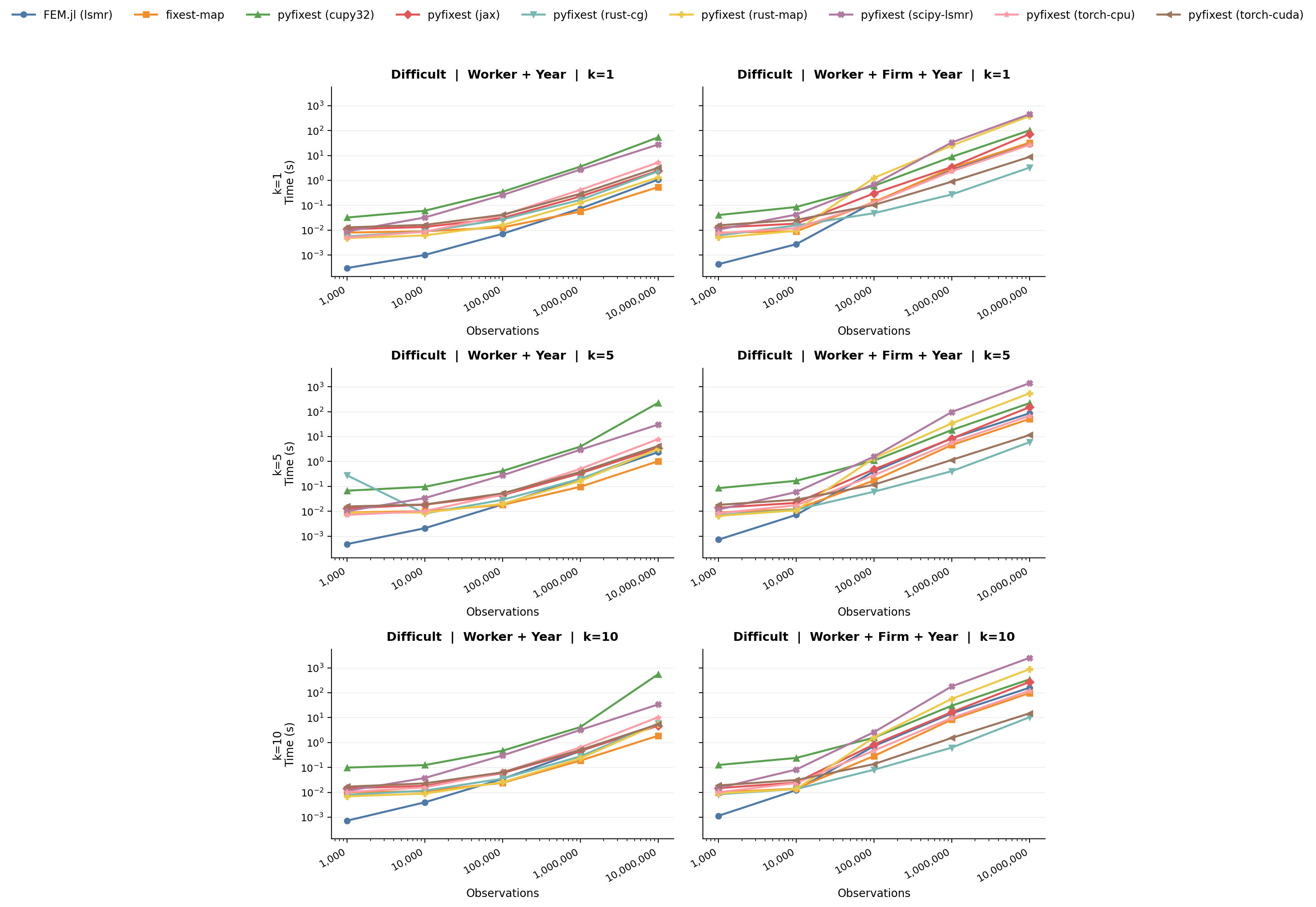
Benchmark on a sparse fixed effects structure: vanilla MAP degrades dramatically, while within LSMR via pf.LsmrDemeaner() remains fast.
For a detailed explanation of why some fixed effects problems are harder than others and comprehensive benchmarks, see When Are Fixed Effects Estimations Difficult?.
The new backend can also be accessed via standalone Python and Rust packages that are available on PyPI and crates.io (see also the GitHub repo).
Special shoutout to Kristof from the appliedAI Institute who developed and implemented the new algorithm.
Reworked Formula Parsing and New i() Operator
The formula parsing module has been significantly reworked. The new implementation introduces a cleaner Formula class, a rewritten i() operator that closely follows R’s fixest syntax, and new multiple estimation operators.
New i() operator
The i() operator now follows the fixest naming convention, using :: to separate variable names from levels. It further provides two new arguments: ref2 and bin2 that allow to set reference levels for interacted variables and to bin categoricals.
Simple categorical encoding:
# Coefficient per level, first level dropped when intercept is present
fit = pf.feols("Y ~ i(f1, ref=1)", data=df)
fit.coef().head()
Coefficient
Intercept 2.057429
f1::0.0 -2.544288
f1::2.0 -4.178969
f1::3.0 -3.008269
f1::4.0 -4.307000
Name: Estimate, dtype: float64Factor x Continuous interaction:
# Each level of f1 gets its own slope on X1
fit = pf.feols("Y ~ i(f1, X1, ref=1)", data=df)
fit.coef().head()
Coefficient
Intercept 0.954836
f1::0.0:X1 -1.069505
f1::2.0:X1 -1.803860
f1::3.0:X1 -1.529129
f1::4.0:X1 -2.039220
Name: Estimate, dtype: float64Factor x Factor interaction with ref2:
The ref2 argument controls the reference level of the second variable in a factor-by-factor interaction.
import numpy as np
df["group"] = np.where(df["f1"] < 15, "A", "B")

# Full interaction: f1 levels x group levels
# ref drops from f1, ref2 drops from group
fit = pf.feols("Y ~ i(f1, group, ref=1, ref2='A')", data=df)
fit.coef().head()
Coefficient
Intercept -0.232008
f1::15.0:group::B 1.135519
f1::16.0:group::B 1.985627
f1::17.0:group::B -0.581221
f1::18.0:group::B 1.397231
Name: Estimate, dtype: float64Binning with bin and bin2:
The bin parameter merges categorical levels before encoding. This is useful for collapsing sparse categories. Values not in the mapping are kept unchanged, matching R fixest behavior.
df["size"] = np.where(df["f1"] < 10, "small", np.where(df["f1"] < 20, "medium", "large"))

# Merge 'small' and 'medium' into 'not_large', then use as reference
fit = pf.feols("Y ~ i(size, bin={'not_large': ['small','medium']}, ref='not_large')", data=df)
fit.coef()
Coefficient
Intercept -0.009512
size::large -0.352447
Name: Estimate, dtype: float64bin2 applies binning to the second variable in a factor-by-factor interaction.
mvsw() and multiple estimation
mvsw() for multiverse stepwise — generates all \(2^k\) combinations of the provided variables, including the intercept-only model.
# mvsw: all combinations of X1 and X2
fits = pf.feols("Y ~ mvsw(X1, X2)", data=df)
pf.etable(fits)| Y | ||||
|---|---|---|---|---|
| (1) | (2) | (3) | (4) | |
| coef | ||||
| X1 | -1.000*** (0.085) |
-0.993*** (0.082) |
||
| X2 | -0.178*** (0.023) |
-0.176*** (0.022) |
||
| Intercept | -0.127 (0.073) |
0.919*** (0.112) |
-0.150* (0.071) |
0.889*** (0.108) |
| stats | ||||
| Observations | 999 | 998 | 999 | 998 |
| R2 | 0 | 0.123 | 0.055 | 0.177 |
| Significance levels: * p < 0.05, ** p < 0.01, *** p < 0.001. Format of coefficient cell: Coefficient (Std. Error) | ||||
Multiple estimation operators can be combined:
# mvsw: all combinations of X1 and X2
fits = pf.feols("Y ~ sw(X1, X2) + csw(f1,f2)", data=df)
pf.etable(fits)| Y | ||||
|---|---|---|---|---|
| (1) | (2) | (3) | (4) | |
| coef | ||||
| X1 | -1.003*** (0.085) |
-1.014*** (0.085) |
||
| f1 | 0.005 (0.008) |
0.005 (0.008) |
0.005 (0.008) |
0.005 (0.008) |
| f2 | -0.018* (0.008) |
-0.012 (0.008) |
||
| X2 | -0.178*** (0.023) |
-0.177*** (0.023) |
||
| Intercept | 0.847*** (0.157) |
1.128*** (0.197) |
-0.219 (0.136) |
-0.046 (0.181) |
| stats | ||||
| Observations | 997 | 997 | 998 | 998 |
| R2 | 0.123 | 0.128 | 0.056 | 0.058 |
| Significance levels: * p < 0.05, ** p < 0.01, *** p < 0.001. Format of coefficient cell: Coefficient (Std. Error) | ||||
Last, you can run operations within the operators:
# mvsw: all combinations of X1 and X2
fits = pf.feols("Y ~ sw(X1, f1 + X2)", data=df)
pf.etable(fits)| Y | ||
|---|---|---|
| (1) | (2) | |
| coef | ||
| X1 | -1.000*** (0.085) |
|
| f1 | 0.005 (0.008) |
|
| X2 | -0.178*** (0.023) |
|
| Intercept | 0.919*** (0.112) |
-0.219 (0.136) |
| stats | ||
| Observations | 998 | 998 |
| R2 | 0.123 | 0.056 |
| Significance levels: * p < 0.05, ** p < 0.01, *** p < 0.001. Format of coefficient cell: Coefficient (Std. Error) | ||
Deprecations
FixestFormulaParseris deprecated in favor ofFormula.parse(). AFutureWarningis emitted when the old class is used.model_matrix_fixest()is deprecated in favor ofcreate_model_matrix().
Migration to maketables
The table functionality in pyfixest now uses maketables. maketables is a spin-off of pyfixest internal functions, but supports more packages in the Python eco-system (e.g. statsmodels and linearmorels). Due to it’s close connection to pyfixest, the API of pf.etable() remains unchanged. Changes:
pf.etable()now usesmaketables.ETableinternally. The API remains unchanged for backward compatibility.- Because the function is not at the core of
pyixestfunctionality, we will deprecatepf.dtable(). AFutureWarningis now emitted. The function has been moved tomaketablesand can be used by callingmaketables.DTable()directly. - The same applies for
pf.make_table(), which has been an internal utility function to create tables. An equivalent function now lives inmaketables.MTable(). - The
great_tablesdependency has been replaced withmaketables.
Migration guide:
# dtable migration
# Before:
pf.dtable(df, vars=["Y", "X1"])
# After:
import maketables
maketables.DTable(df, vars=["Y", "X1"])

# make_table migration
# Before:
pf.make_table(df, type="gt", caption="My Table")
# After:
import maketables
maketables.MTable(df, caption="My Table").make(type="gt")
Other Changes
- Adds the following statistics to the
Fepoisclass:_loglik,_loglik_null,_pseudo_r2for regression without weights. - Set the default parameters for the MAP algorithm to a tolerance of
1e-06and maximum number of iterations of10_000. - Adds support for weights for poisson regression via
feopis().
GLMs with High-Dimensional Fixed Effects
feglm() now supports high-dimensional fixed effects for logit, probit, and gaussian families! Fixed effects are specified after the | symbol, just like in feols() and fepois().
import numpy as np

data_glm = pf.get_data()
data_glm["Y"] = np.where(data_glm["Y"] > 0, 1, 0)

# Logit with fixed effects
fit_logit = pf.feglm("Y ~ X1 + X2 | f1", data=data_glm, family="logit")
fit_logit.summary()
###
Estimation: Logit
Dep. var.: Y, Fixed effects: f1
sample: None = all
Inference: iid
Observations: 998
| Coefficient | Estimate | Std. Error | t value | Pr(>|t|) | 2.5% | 97.5% |
|:--------------|-----------:|-------------:|----------:|-----------:|-------:|--------:|
| X1 | -1.016 | 0.109 | -9.297 | 0.000 | -1.231 | -0.802 |
| X2 | -0.166 | 0.028 | -5.831 | 0.000 | -0.222 | -0.110 |
---
Deviance: 961.445 Fixed effects estimation via demeaning produces identical point estimates as one-hot encoding the fixed effects via C():
# Compare FE demeaning vs one-hot encoding
fit_logit_onehot = pf.feglm("Y ~ X1 + X2 + C(f1)", data=data_glm, family="logit")

pf.etable([fit_logit, fit_logit_onehot])| Y | ||
|---|---|---|
| (1) | (2) | |
| coef | ||
| X1 | -1.016*** (0.109) |
-1.016*** (0.109) |
| X2 | -0.166*** (0.028) |
-0.166*** (0.028) |
| f1=1.0 | 2.653*** (0.610) |
|
| f1=2.0 | -2.673** (0.844) |
|
| f1=3.0 | -0.236 (0.569) |
|
| f1=4.0 | -2.385** (0.745) |
|
| f1=5.0 | 1.653** (0.628) |
|
| f1=6.0 | -1.587* (0.691) |
|
| f1=7.0 | 0.319 (0.542) |
|
| f1=8.0 | -0.061 (0.531) |
|
| f1=9.0 | 0.448 (0.529) |
|
| f1=10.0 | 0.505 (0.528) |
|
| f1=11.0 | 1.375* (0.568) |
|
| f1=12.0 | 0.050 (0.562) |
|
| f1=13.0 | 0.979 (0.567) |
|
| f1=14.0 | -0.602 (0.580) |
|
| f1=15.0 | 0.942 (0.561) |
|
| f1=16.0 | 2.678*** (0.644) |
|
| f1=17.0 | -0.862 (0.621) |
|
| f1=18.0 | 1.514** (0.561) |
|
| f1=19.0 | 0.453 (0.560) |
|
| f1=20.0 | 2.225*** (0.579) |
|
| f1=21.0 | -2.048** (0.682) |
|
| f1=22.0 | -1.482* (0.607) |
|
| f1=23.0 | -1.125 (0.624) |
|
| f1=24.0 | -0.843 (0.573) |
|
| f1=25.0 | -1.485 (0.762) |
|
| f1=26.0 | 0.785 (0.578) |
|
| f1=27.0 | -0.488 (0.578) |
|
| f1=28.0 | 1.815*** (0.540) |
|
| f1=29.0 | 0.825 (0.573) |
|
| Intercept | 0.631 (0.393) |
|
| fe | ||
| f1 | x | - |
| stats | ||
| Observations | 998 | 998 |
| R2 | - | - |
| Significance levels: * p < 0.05, ** p < 0.01, *** p < 0.001. Format of coefficient cell: Coefficient (Std. Error) | ||
Note that standard errors may differ between the two approaches due to different degrees of freedom adjustments.
All three GLM families (gaussian, logit, probit) support fixed effects:
fit_gaussian = pf.feglm("Y ~ X1 + X2 | f1", data=data_glm, family="gaussian")
fit_probit = pf.feglm("Y ~ X1 + X2 | f1", data=data_glm, family="probit")

pf.etable([fit_gaussian, fit_logit, fit_probit])| Y | |||
|---|---|---|---|
| (1) | (2) | (3) | |
| coef | |||
| X1 | -0.166*** (0.016) |
-1.016*** (0.109) |
-0.588*** (0.062) |
| X2 | -0.025*** (0.004) |
-0.166*** (0.028) |
-0.097*** (0.016) |
| fe | |||
| f1 | x | x | x |
| stats | |||
| Observations | 998 | 998 | 998 |
| R2 | 0.351 | - | - |
| Significance levels: * p < 0.05, ** p < 0.01, *** p < 0.001. Format of coefficient cell: Coefficient (Std. Error) | |||
PyFixest 0.40.1
Breaking Changes for compatibility with fixest 0.13
fixest 0.13 has recently been released to CRAN, with a range of breaking changes. We are following these in pyfixet 0.40.0.
- The default inference method is now always “iid”. Before, both
fixestandpyfixestwould default to cluster by the first fixest effect in the presence of fixed effect. - The arguments of the
pf.ssc()functions have been renamed:adjbecomesk_adj,fixef_kbecomesk_fixef,cluster_dfbecomesG_df, andcluster_adjbecomesG_adj. Backwards compatibility is ensured. fixestno longer applies theG/(G-1)small sample correction for heteroskedastic errors. The argument is now only relevant for cluster robust errors.- If the
k_adjarg is set toTruewith heteroskedastic errors, the applied small sample correction now isN / (N-k)and no longer(N-1) / (N-df_k), as was previously the case and is still the case for iid and cluster robust errors. - The
k_fixefoption"nested"has been renamed to"nonnested". - The
fixef_rmargument is changed from default"none"to"singleton"for all estimation functions. This has no impact on point estimates, but might change inference due to a smaller number of observations in the degree of freedom correction. - The multicollinearity default tolerance has been reduced from 1e-10 to 1e-09.
- The attribute
_dof_khas been renamed to_df_k.
Other related changes: - The arguments to adjust the small samples for the wildboottest methods have been renamed to k_adj and G_adj.
Moved to pixi.toml and install from conda-forge
We have been using pixi as our package manager for a while and are moving from a pyproject.toml to using a pixi.toml for specifying dependencies. We also install all package by default from the free and open source conda-forge. Because of some environment resolution challenges around an old version of rpy2that we need for testing pyfixest against fixest, we temporarily have dropped support for the dev and docs environments for windows. A fix is work in progress.
New Features
CuPy and SciPy Backends via LSMR
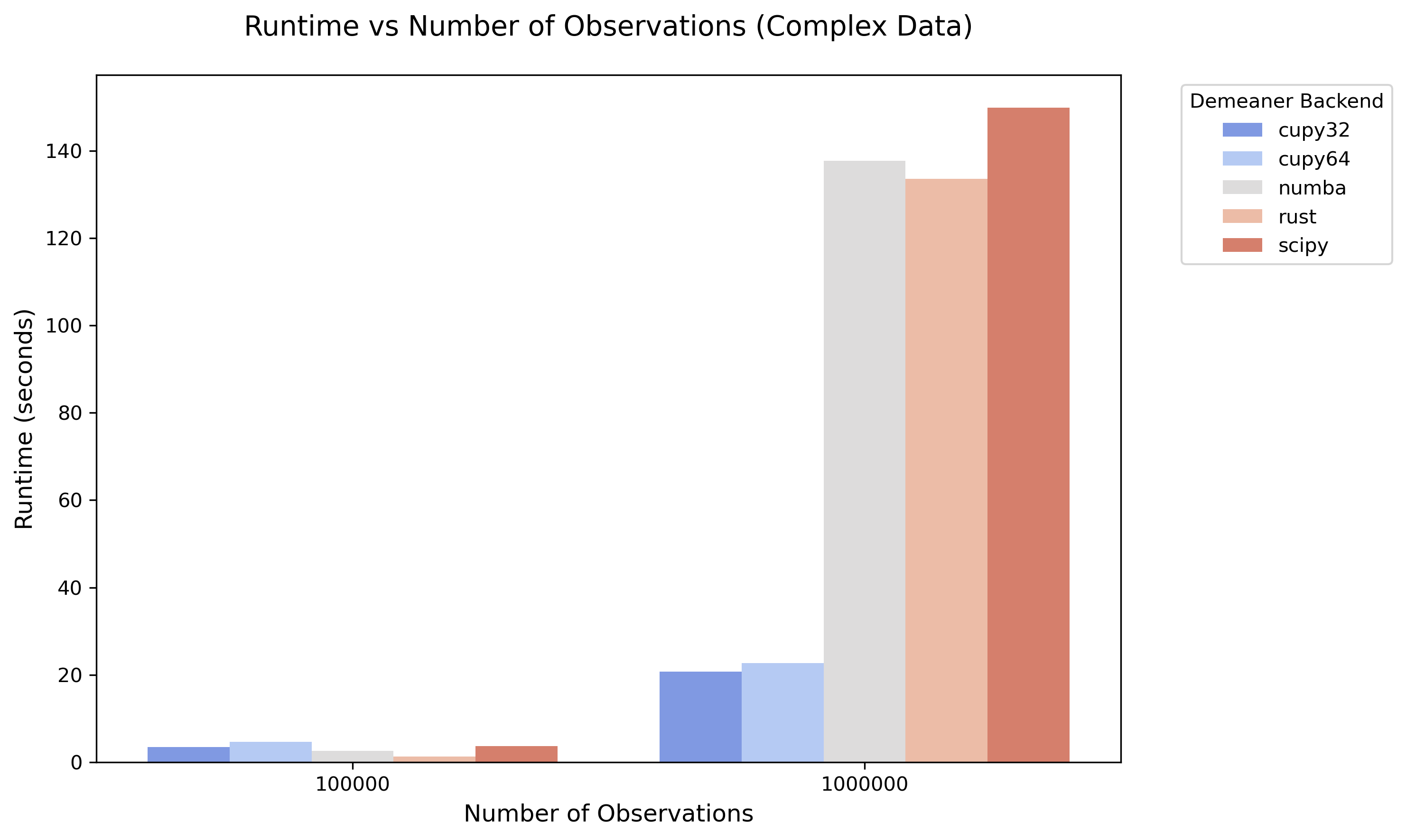
We add CuPy and SciPy Backend to run the demeaning algorithm on the GPU via the sparse LSMR solver. For problems where the standard demeaner struggles to converge, this strategy can lead to significant speedups if paired with a GPU.
HAC Standard Errors
We now support HAC standard errors! Thanks for Daman (https://github.com/damandhaliwal) for all his work (and coping with me with the PR, which took forever to get through). We now support:
- time series HAC
- panel HAC
- panel DK
variance-covariance matrices.
For now, we assume that the time series column is consecutive and each entry has “time delta 1”. Relaxation of this requirement are work in progress.
cat_template argument for plotting functions
For easier encoding of categorical variables in relation to the iplot() and coefplot() functions, we add a new function argument, cat_template:
fit_c = pf.feols(fml = "Y ~ i(X1, f1)", data = df)
fit_c.iplot(cat_template = "{variable}::{value}")
This is particularly useful for Difference-in-Differences and event studies. You can find an example use case in the DiD vignette.
Going forward, we will deprecate the rename_event_study_coefs function, which is no longer needed (and did not work anyways).
Updates to Gelbach Decomposition
We have reworked the Gelbach Decomposition method, with some breaking changes: by default, calling Feols.decompose() now returns a GelbachDecomposition instance - before, we’d return a pd.DataFrame. The param argument has been renamed to decomp_var, but is not yet deprecated.
The class now comes with new tidy() and etable() methods.
from pyfixest.utils.dgps import gelbach_data
import numpy as np
import pyfixest as pf

# Generate test data using gelbach_data
data = gelbach_data(nobs=500)
data["w"] = np.random.rand(500)
fit = pf.feols("y ~ x1 + x21 + x22 + x23", data=data)
gb = fit.decompose(decomp_var = "x1", x1_vars = ["x21"],reps = 10, nthreads = 1)
print(type(gb))
<class 'pyfixest.estimation.post_estimation.decomposition.GelbachDecomposition'>It is now also possible to add background variables that are included in both the long and short regressions via the x1_vars function argument.
We can inspect results as a pd.DataFrame
gb.tidy()| coefficients | ci_lower | ci_upper | panels | |
|---|---|---|---|---|
| direct_effect | 1.412165 | 1.193808 | 2.397195 | Levels (units) |
| full_effect | 1.041753 | 1.029726 | 1.087159 | Levels (units) |
| explained_effect | 0.370412 | 0.125204 | 1.314523 | Levels (units) |
| unexplained_effect | 1.041753 | 1.029726 | 1.087159 | Levels (units) |
| x22 | 0.061930 | -0.113556 | 0.604015 | Levels (units) |
| x23 | 0.308483 | 0.226991 | 0.710508 | Levels (units) |
| direct_effect | 1.000000 | 1.000000 | 1.000000 | Share of Full Effect |
| full_effect | 0.737699 | 0.458564 | 0.895591 | Share of Full Effect |
| explained_effect | 0.262301 | 0.104409 | 0.541436 | Share of Full Effect |
| unexplained_effect | 0.737699 | 0.458564 | 0.895591 | Share of Full Effect |
| x22 | 0.043855 | -0.094647 | 0.246730 | Share of Full Effect |
| x23 | 0.218446 | 0.184146 | 0.301104 | Share of Full Effect |
| direct_effect | 3.812414 | 1.872930 | 9.752321 | Share of Explained Effect |
| full_effect | 2.812414 | 0.872930 | 8.752321 | Share of Explained Effect |
| explained_effect | 1.000000 | 1.000000 | 1.000000 | Share of Explained Effect |
| unexplained_effect | 2.812414 | 0.872930 | 8.752321 | Share of Explained Effect |
| x22 | 0.167192 | -0.941785 | 0.455750 | Share of Explained Effect |
| x23 | 0.832808 | 0.544250 | 1.941785 | Share of Explained Effect |
or produce a GT table:
gb.etable(
    stats = "all",
    caption = "Gelbach Decomposition"
)| Gelbach Decomposition | |||
| Initial Difference | Adjusted Difference | Explained Difference | |
|---|---|---|---|
| Levels (units) | |||
| x1 | 1.412 | 1.042 | 0.370 |
| [1.194, 2.397] | [1.030, 1.087] | [0.125, 1.315] | |
| x22 | - | - | 0.062 |
| - | - | [-0.114, 0.604] | |
| x23 | - | - | 0.308 |
| - | - | [0.227, 0.711] | |
| Share of Full Effect | |||
| x1 | 1.000 | 0.738 | 0.262 |
| - | [0.459, 0.896] | [0.104, 0.541] | |
| x22 | - | - | 0.044 |
| - | - | [-0.095, 0.247] | |
| x23 | - | - | 0.218 |
| - | - | [0.184, 0.301] | |
| Share of Explained Effect | |||
| x1 | - | - | 1.000 |
| x22 | - | - | 0.167 |
| - | - | [-0.942, 0.456] | |
| x23 | - | - | 0.833 |
| - | - | [0.544, 1.942] | |
| Decomposition variable: x1. Control Variables: x21. CIs are computed using B = 10 bootstrap replications using iid sampling.Col 1: Adjusted Difference (by x21) - Coefficient on x1 in short regression. Col 2: Adjusted Difference - Coefficient on x1 in long regression. Col 3: Explained Difference - Difference in coefficients of x1 in short and long regression. Panel 1: Levels (units). Panel 2: Share of Full Effect: Levels normalized by coefficient of the short regression. Panel 3: Share of Explained Effect: Levels normalized by coefficient of the long regression. | |||
As can be seen, we by default now return normalized (and not just absolute) effects.
We are now also supporting frequency weights for the decomposition (currently without inference).
Additionally, some house keeping and interal refactoring of the GelbachDecomposition class.
PyFixest 0.30.0
New Features
- We have created a Rust backend for all performance critical algorithms, with pretty great performance improvements! You can use the Rust backend by setting
demeaner_options = "rust".
We find pretty great performance improvements and want to make the Rust backend the default in PyFixest 0.31.0.
To back up the performance claim, here is a benchmark:
import pyfixest as pf
import numpy as np
import pandas as pd
import time

rng = np.random.default_rng(737)

N = 10_000_000
benchmark_data = pd.DataFrame({
  "Y": rng.normal(0, 1, N),
  "X1": rng.normal(0, 1, N),
  "X2": rng.normal(0, 1, N),
  "X3": rng.normal(0, 1, N),
  "f1": rng.integers(0, 10_000, N),
  "f2": rng.integers(0, 1_000, N),
  "f3": rng.integers(0, 10, N),
})

# burn-in for numba
fit_nb_warmup = pf.feols(
  fml = "Y ~ X1 + X2 + X3 | f1 + f2 + f3", data = benchmark_data[:100_000]
)

# benchmark for numba backend
tic = time.time()
fit_nb = pf.feols(
  fml = "Y ~ X1 + X2 + X3 | f1 + f2 + f3", data = benchmark_data
)
toc = time.time()
print(f"Numba backend took {toc-tic}.")

# benchmark for rust backend
tic = time.time()
fit_rust = pf.feols(
  fml = "Y ~ X1 + X2 + X3 | f1 + f2 + f3", data = benchmark_data,
  demeaner = pf.MapDemeaner(backend="rust")
)
toc = time.time()
print(f"Rust backend took {toc-tic}.")
Numba backend took 2.1796035766601562.
Rust backend took 1.853517770767212.Results are also matching =)
pf.etable([fit_nb, fit_rust], digits = 8)| Y | ||
|---|---|---|
| (1) | (2) | |
| coef | ||
| X1 | 0.000 (0.000) |
0.000 (0.000) |
| X2 | 0.000 (0.000) |
0.000 (0.000) |
| X3 | 0.001* (0.000) |
0.001* (0.000) |
| fe | ||
| f1 | x | x |
| f2 | x | x |
| f3 | x | x |
| stats | ||
| Observations | 10,000,000 | 10,000,000 |
| R2 | 0.001 | 0.001 |
| Significance levels: * p < 0.05, ** p < 0.01, *** p < 0.001. Format of coefficient cell: Coefficient (Std. Error) | ||
- We now support quantile regression, including a Frisch-Newton Interior Point Solver with and without preprocessing, iid, heteroskedastic and cluster robust standard errors, fast algorithms for the entire quantile regression process, and some visualisations. In particular the algorithms for the quantile regression process show excellent performance. You can learn more about all features and take a look at more systematic benchmarks in the quantreg vignette.
N_qr = 10_000
rng = np.random.default_rng(929)

df_qr = pd.DataFrame({
  "X1": rng.normal(0, 1, N_qr),
  "X2": rng.normal(0, 1, N_qr)
})
df_qr["Y"] = -0.5 + -2 * df_qr["X1"] + 1.9 * df_qr["X1"] ** 4 + df_qr["X2"] - 0.4 * df_qr["X2"] **7 + rng.normal(0, 1, N_qr)

fit_qr = pf.quantreg(
  fml = "Y ~ X1 + X2",
  data = df_qr,
  quantile = [0.1, 0.2, 0.3, 0.4, 0.5, 0.6, 0.7, 0.8, 0.9],
  method = "pfn",
  multi_method = "cfm2"
)

pf.qplot(fit_qr, figsize = [7,3])Bug Fixes
Documentation
Infrastructure
- We have reorganized our tests and rely more on conda environments for making R package test dependencies available: link
Community
- We have added a Code of Conduct.
- We have opened our discord community. Please join us there to discuss pyfixest and other py-econometrics projects! Link here.
New Contributors
- @FuZhiyu made their first contribution in https://github.com/py-econometrics/pyfixest/pull/886
- @mortizm1988 made their first contribution in https://github.com/py-econometrics/pyfixest/pull/895
- @jestover made their first contribution in https://github.com/py-econometrics/pyfixest/pull/897
- @JaapCTJ made their first contribution in https://github.com/py-econometrics/pyfixest/pull/900
- @shapiromh made their first contribution in https://github.com/py-econometrics/pyfixest/pull/906
- @schroedk made their first contribution in https://github.com/py-econometrics/pyfixest/pull/905
- @WiktorTheScriptor made their first contribution in https://github.com/py-econometrics/pyfixest/pull/938
- @damandhaliwal made their first contribution in https://github.com/py-econometrics/pyfixest/pull/944
Full Changelog: https://github.com/py-econometrics/pyfixest/compare/v0.29.0…v0.30.0
PyFixest 0.29.0
We add options
fixef_k = "nested"andfixef_k = "full"for computing small sample corrections viapf.ssc(). We set the defaults forpf.feols()and other estimation functions tofixef_k = "nested"to 100% mimic the defaults ofr-fixest. This is a “breaking change” in the sense that it might (slightly) impact the standard errors of your estimations.We add support for fully saturated event study estimation via the
SaturatedEventStudyclass, which can be called viapf.event_study().We add support for difference-in-differences specification tests following Lal (2025).
We add R2-within values to the default
etable()output.We fix a small bug in the Gelbach
decompose()method, which would fail if a user selectedonly_coef = True.The
decompose()method runs fully on sparse matrices, which leads to large performance improvements on big data sets.We fix a small bug in the
predict()method withnewdata, see here for details.We add a function argument
rename_modelsto help rename model names in thecoefplot()andiplot()functions and methods:pf.coefplot( models = [fit1, fit2, fit3], rename_models = { fit1._model_name_plot: "Model 1", fit2._model_name_plot: "Model 2", fit3._model_name_plot: "Model 3" }, )Made
lets-plotan optional dependency. The package will now fall back tomatplotlibfor plotting iflets-plotis not installed. Users can installlets-plotwithpip install pyfixest[plots].PyFixest now supports R2, adjusted R2, and within-R2 values for WLS (it previously only did for OLS, if at all).
We add support for standard error of predictions for OLS models without fixed effects. As a default, the predict model still returns a
np.ndarray. If the argumentse_fitis set toTrue, we report the prediction standard errors. If argumentinterval = "prediction", we return apd.DataFramewith predictions, their standard errors, and confidence intervals.
PyFixest 0.28.0
New features and bug fixes
- Adds a function argument
context, that allows to pass information / context to theformulaic.Formulaic.get_model_matrix()call that creates the model matrix. - Fix a bug that caused reindexing of
LPDID._coeftablewhen callingLPDID.iplot(). As a result, a second call ofLPDID.iplot()would fail. - Bumps the required
formulaicversion to1.1.0and fixes errors that arose when a) the ref argument was used for i() syntax, which led to a silent failure under formulaic >= 1.1.0, and fixef() / predict() with fixed effects, which led to a loud error.
New experimental Features
- Adds a
pf.feglm()function that supports GLMs with normal and binomial families (gaussian, logit, probit) without fixed effects. Fixed effects support is work in progress. - Adds options to run the demean function via JAX. This might speed up the model fit if GPU is available.
PyFixest 0.27.0
- Adds support for Gelbach’s (JoLe 2016) Regression Decomposition method using a
decompose()method forFeols. - Adds support for the multiple hypothesis correction by Westfall & Young via the
pf.wyoung()function. - Input data frames to
pf.feols()andpf.fepois()are now converted topandasvia narwhals. As a result, users can not provideduckdboribistables as inputs, as well aspandasandpolarsdata frames.polarsandpyarroware dropped as a dependencies. - Fixes a bug in the
wildboottestmethod, which incorrectly used to run a regression on the demeaned dependend variable in case it was applied after a fixed effects regression. My apologies for that! - Fixes a bug in the
ritestmethod, which would use randomization inference coefficients instead of t-statistics, leading to incorrect results. This has consequences for the rwolf() function, which, in case of running ri-inference, would default to run the randomization-t. My apolgies! - Adds a vignette on multiple testing corrections.
- Adds a vignette on Gelbach’s regression decomposition.
PyFixest 0.22.0 - 0.25.4
See the github changelog for details: link.
PyFixest 0.22.0
Changes
- Fix bug in wildboottest method @s3alfisc (#506)
- docs: add sanskriti2005 as a contributor for infra @allcontributors (#503)
- Infra: added the release-drafter for automation of release notes @sanskriti2005 (#502)
- Fix broken link in contributing.md @s3alfisc (#499)
- docs: add leostimpfle as a contributor for bug @allcontributors (#495)
- Update justfile @leostimpfle (#494)
- docs: add baggiponte as a contributor for doc @allcontributors (#490)
- docs: improve installation section @baggiponte (#489)
- Bump tornado from 6.4 to 6.4.1 @dependabot (#487)
- docs: add leostimpfle as a contributor for code @allcontributors (#478)
- Feols: speed up the creation of interacted fixed effects via
fe1^fe2syntax @leostimpfle (#475) - rename resampling iterations to ‘reps’ in all methods @s3alfisc (#474)
- fix a lot of broken links throught the repo @s3alfisc (#472)
- Multiple readme fixes required after package was moved to py-econometrics project @s3alfisc (#450)
Infrastructure
- infrastructure: fix minor release drafter bugs @s3alfisc (#504)
PyFixest 0.21.0
- Add support for randomization inference via the
ritest()method:
import pyfixest as pf
data = pf.get_data()

fit = pf.feols("Y ~ X1", data = data)
fit.ritest(resampvar="X1=0", reps = 1000)
PyFixest 0.20.0
- This version introduces MyPy type checks to the entire pyfixest codebase. Thanks to @juanitorduz for nudging me to get started with this =). It also fixes a handful of smaller bugs.
PyFixest 0.19.0
- Fixes multiple smaller and larger performance regressions. The NYC-Taxi example regression now takes approximately 22 seconds to run (… if my laptopt is connected to a power charger)!
%load_ext autoreload
%autoreload 2

import duckdb
import time
import numpy as np
import pyfixest as pf

# %%
nyc = duckdb.sql(
    '''
    FROM 'C:/Users/alexa/Documents/nyc-taxi/**/*.parquet'
    SELECT
        tip_amount, trip_distance, passenger_count,
        vendor_id, payment_type, dropoff_at,
        dayofweek(dropoff_at) AS dofw
    WHERE year = 2012 AND month <= 3
    '''
    ).df()

# convert dowf, vendor_id, payment_type to categorical
tic = time.time()
nyc["dofw"] = nyc["dofw"].astype(int)
nyc["vendor_id"] = nyc["vendor_id"].astype("category")
nyc["payment_type"] = nyc["payment_type"].astype("category")
print(f"""
    I am convering columns of type 'objects' to 'categories' and 'int'data types outside
    of the regression, hence I am cheating a bit. This saves {np.round(time.time() - tic)} seconds.
    """
)
#    I am convering columns of type 'objects' to 'categories' and 'int'data types outside
#    of the regression, hence I am cheating a bit. This saves 7.0 seconds.

run = True
if run:

    # mock regression for JIT compilation
    fit = pf.feols(
        fml = "tip_amount ~ trip_distance + passenger_count | vendor_id + payment_type + dofw",
        data = nyc.iloc[1:10_000],
        copy_data = False,
        store_data = False
        )

    import time
    tic = time.time()
    fit = pf.feols(
        fml = "tip_amount ~ trip_distance + passenger_count | vendor_id + payment_type + dofw",
        data = nyc,
        copy_data = False, # saves a few seconds
        store_data = False # saves a few second
        )
    passed = time.time() - tic
    print(f"Passed time is {np.round(passed)}.")
# Passed time is 22.- Adds three new function arguments to
feols()andfepois():copy_data,store_data, andfixef_tol. - Adds support for frequency weights with the
weights_typefunction argument.
import pyfixest as pf

data = pf.get_data(N = 10000, model = "Fepois")
df_weighted = data[["Y", "X1", "f1"]].groupby(["Y", "X1", "f1"]).size().reset_index().rename(columns={0: "count"})
df_weighted["id"] = list(range(df_weighted.shape[0]))

print("Dimension of the aggregated df:", df_weighted.shape)
print(df_weighted.head())

fit = pf.feols(
    "Y ~ X1 | f1",
    data = data
)
fit_weighted = pf.feols(
    "Y ~ X1 | f1",
    data = df_weighted,
    weights = "count",
    weights_type = "fweights"
)
pf.etable([fit, fit_weighted], coef_fmt = "b(se) \n (t) \n (p)")
Dimension of the aggregated df: (1278, 5)
Y X1 f1 count id
0 0.0 0.0 0.0 17 0
1 0.0 0.0 1.0 11 1
2 0.0 0.0 2.0 10 2
3 0.0 0.0 3.0 17 3
4 0.0 0.0 4.0 14 4| Y | ||
|---|---|---|
| (1) | (2) | |
| coef | ||
| X1 | 0.001(0.012) (0.088) (0.93) |
0.001(0.012) (0.088) (0.93) |
| fe | ||
| f1 | x | x |
| stats | ||
| Observations | 9,996 | 9,996 |
| R2 | 0.011 | 0.011 |
| Format of coefficient cell: Coefficient(Std. Error) (t-stats) (p-value) | ||
- Bugfix: Wild Cluster Bootstrap Inference with Weights would compute unweighted standard errors. Sorry about that! WLS is not supported for the WCB.
- Adds support for CRV3 inference with weights.
PyFixest 0.18.0
- Large Refactoring of Interal Processing of Model Formulas, in particular
FixestFormulaParserandmodel_matrix_fixest. As a results, the code should be cleaner and more robust. - Thanks to the refactoring, we can now bump the required
formulaicversion to the stable1.0.0release. - The
fmlargument ofmodel_matrix_fixestis deprecated. Instead,model_matrix_fixestnow asks for aFixestFormula, which is essentially a dictionary with information on model specifications like a first stage formula (if applicable), dependent variables, fixed effects, etc. - Additionally,
model_matrix_fixestnow returns a dictionary instead of a tuple. - Brings back fixed effects reference setting via
i(var1, var2, ref)syntax. Deprecates thei_ref1,i_ref2function arguments. I.e. it is again possible to e.g. run
import pyfixest as pf
data = pf.get_data()

fit1 = pf.feols("Y ~ i(f1, X2)", data=data)
fit1.coef()[0:8]
Via the ref syntax, via can set the reference level:
fit2 = pf.feols("Y ~ i(f1, X2, ref = 1)", data=data)
fit2.coef()[0:8]
PyFixest 0.17.0
Restructures the codebase and reorganizes how users can interact with the
pyfixestAPI. It is now recommended to usepyfixestin the following way:import numpy as np import pyfixest as pf data = pf.get_data() data["D"] = data["X1"] > 0 fit = pf.feols("Y ~ D + f1", data = data) fit.tidy()Estimate Std. Error t value Pr(>|t|) 2.5% 97.5% Coefficient Intercept 0.778849 0.170261 4.574437 0.000005 0.444737 1.112961 D -1.402617 0.152224 -9.214140 0.000000 -1.701335 -1.103899 f1 0.004774 0.008058 0.592508 0.553645 -0.011038 0.020587 The update should not inroduce any breaking changes. Thanks to @Wenzhi-Ding for the PR!
Adds support for simultaneous confidence intervals via a multiplier bootstrap. Thanks to @apoorvalal for the contribution!
fit.confint(joint = True)2.5% 97.5% Intercept 0.381982 1.175716 D -1.757441 -1.047793 f1 -0.014008 0.023557 Adds support for the causal cluster variance estimator by Abadie et al. (QJE, 2023) for OLS via the
.ccv()method.fit.ccv(treatment = "D", cluster = "group_id")Estimate Std. Error t value Pr(>|t|) 2.5% 97.5% CCV -1.402617 0.257029 -5.457031 0.000035 -1.942615 -0.862618 CRV1 -1.402617 0.205132 -6.837621 0.000002 -1.833584 -0.971650
PyFixest 0.16.0
- Adds multiple quality of life improvements for developers, thanks to NKeleher.
- Adds more options to customize
etable()output thanks to Wenzhi-Ding. - Implements Romano-Wolf and Bonferroni corrections for multiple testing in the
multcompmodule.
PyFixest 0.15.
- Adds support for weighted least squares for
feols(). - Reduces testing time drastically by running tests on fewer random data samples. Qualitatively, the set of test remains identical.
- Some updates for future
pandascompatibility.
PyFixest 0.14.0
- Moves the documentation to quartodoc.
- Changes all docstrings to
numpyformat. - Difference-in-differences estimation functions now need to be imported via the
pyfixest.did.estimationmodule:
from pyfixest.did.estimation import did2s, lpdid, event_studyPyFixest 0.13.5
- Fixes a bug that lead to incorrect results when the dependent variable and all covariates (excluding the fixed effects) where integers.
PyFixest 0.13.4
- Fixes a bug in
etable()with IV’s that occurred becausefeols()does not report R2 statistics for IVs.
PyFixest 0.13.2
- Fixes a bug in
etable()and a warning infixest_model_matrixthat arose with higherpandasversions. Thanks to @aeturrell for reporting!
PyFixest 0.13.0
New Features
- Introduces a new
pyfixest.didmodule which contains routines for Difference-in-Differences estimation. - Introduces support for basic versions of the local projections DiD estimator following Dube et al (2023)
- Adds a new vignette for Difference-in-Differences estimation.
- Reports R2 values in
etable().
PyFixest 0.12.0
Enhancements:
- Good performance improvements for singleton fixed effects detection. Thanks to @styfenschaer for the PR! See #229.
- Uses the r2u project for installing R and R packages on github actions, with great performance improvements.
- Allows to pass
polarsdata frames tofeols(),fepois()andpredict(). #232. Thanks to @vincentarelbundock for the suggestion!
Bug Fixes:
- Missing variables in features were not always handled correctly in
predict()withnewdatanotNonein the presence of missing data, which would lead to an error. See #246 for details. - Categorical variables were not always handled correctly in
predict()withnewdatanotNone, because the number of fixed effects levels innewdatamight be smaller than indata. In consequence, some levels were not found, which lead to an error. See #245 for details. Thanks to @jiafengkevinchen for the pointer! - Multicollinearity checks for over-identified IV was not implemented correctly, which lead to a dimension error. See #236 for details. Thanks to @jiafengkevinchen for the pointer!
- The number of degrees of freedom
kwas computed incorrectly if columns were dropped from the design matrixXin the presence of multicollinearity. See #235 for details. Thanks to @jiafengkevinchen for the pointer! - If all variables were dropped due to multicollinearity, an unclear and imprecise error message was produced. See #228 for details. Thanks to @manferdinig for the pointer!
- If selection
fixef_rm = 'singleton',feols()andfepois()would fail, which has been fixed. #192
Dependency Requirements
- For now, sets
formulaicversions to be0.6.6or lower as version1.0.0seems to have introduced a problem with thei()operator, See #244 for details. - Drops dependency on
pyhdfe.
PyFixest 0.11.1
- Fixes some bugs around the computation of R-squared values (see issue #103).
- Reports R-squared values again when calling
.summary().
PyFixest 0.11.0
- Significant speedups for CRV1 inference.
PyFixest 0.10.12
Fixes a small bug with the separation check for poisson regression #138.
PyFixest 0.10.11
Fixes bugs with i(var1, var2) syntax introduced with PyFixest 0.10.10.
PyFixest 0.10.10
Fixes a bug with variable interactions via i(var) syntax. See issue #221.
PyFixest 0.10.9
Makes etable() prettier and more informative.
PyFixest 0.10.8
Breaking changes
Reference levels for the i() formula syntax can no longer be set within the formula, but need to be added via the i_ref1 function argument to either feols() and fepois().
New feature
A dids2() function is added, which implements the 2-stage difference-in-differences procedure à la Gardner and follows the syntax of @kylebutts did2s R package.
from pyfixest.did.did import did2s
from pyfixest.estimation import feols
from pyfixest.visualize import iplot
import pandas as pd
import numpy as np

df_het = pd.read_csv("https://raw.githubusercontent.com/py-econometrics/pyfixest/master/pyfixest/did/data/df_het.csv")

fit = did2s(
    df_het,
    yname = "dep_var",
    first_stage = "~ 0 | state + year",
    second_stage = "~i(rel_year)",
    treatment = "treat",
    cluster = "state",
    i_ref1 = [-1.0, np.inf],
)

fit_twfe = feols(
    "dep_var ~ i(rel_year) | state + year",
    df_het,
    i_ref1 = [-1.0, np.inf]
)

iplot([fit, fit_twfe], coord_flip=False, figsize = (900, 400), title = "TWFE vs DID2S")
PyFixest 0.10.7
- Adds basic support for event study estimation via two-way fixed effects and Gardner’s two-stage “Did2s” approach. This is a beta version and experimental. Further updates (i.e. proper event studies vs “only” ATTs) and a more flexible did2s front end will follow in future releases.
%load_ext autoreload
%autoreload 2

from pyfixest.did.did import event_study
import pyfixest as pf
import pandas as pd
df_het = pd.read_csv("pyfixest/did/data/df_het.csv")

fit_twfe = event_study(
    data = df_het,
    yname = "dep_var",
    idname= "state",
    tname = "year",
    gname = "g",
    estimator = "twfe"
)

fit_did2s = event_study(
    data = df_het,
    yname = "dep_var",
    idname= "state",
    tname = "year",
    gname = "g",
    estimator = "did2s"
)

pf.etable([fit_twfe, fit_did2s])
# | Coefficient   | est1             | est2             |
# |:--------------|:-----------------|:-----------------|
# | ATT           | 2.135*** (0.044) | 2.152*** (0.048) |
# Significance levels: * p < 0.05, ** p < 0.01, *** p < 0.001
PyFixest 0.10.6
- Adds an
etable()function that outputs markdown, latex or a pd.DataFrame.
PyFixest 0.10.5
- Fixes a big in IV estimation that would trigger an error. See here for details. Thanks to @aeturrell for reporting!
PyFixest 0.10.4
- Implements a custom function to drop singleton fixed effects.
- Additional small performance improvements.
PyFixest 0.10.3
- Allows for white space in the multiway clustering formula.
- Adds documentation for multiway clustering.
PyFixest 0.10.2
- Adds support for two-way clustering.
- Adds support for CRV3 inference for Poisson regression.
PyFixest 0.10.1
- Adapts the internal fixed effects demeaning criteron to match `PyHDFE’s default.
- Adds Styfen as coauthor.
PyFixest 0.10
- Multiple performance improvements.
- Most importantly, implements a custom demeaning algorithm in
numba- thanks to Styfen Schaer (@styfenschaer), which leads to performance improvements of 5x or more:
%load_ext autoreload
%autoreload 2

import numpy as np
import time
import pyhdfe
from pyfixest.demean import demean

np.random.seed(1238)
N = 10_000_000
x = np.random.normal(0, 1, 10*N).reshape((N,10))
f1 = np.random.choice(list(range(1000)), N).reshape((N,1))
f2 = np.random.choice(list(range(1000)), N).reshape((N,1))

flist = np.concatenate((f1, f2), axis = 1)
weights = np.ones(N)

algorithm = pyhdfe.create(flist)

start_time = time.time()
res_pyhdfe = algorithm.residualize(x)
end_time = time.time()
print(end_time - start_time)
# 26.04527711868286


start_time = time.time()
res_pyfixest, success = demean(x, flist, weights, tol = 1e-10)
# Calculate the execution time
end_time = time.time()
print(end_time - start_time)
#4.334428071975708

np.allclose(res_pyhdfe , res_pyfixest)
# True
PyFixest 0.9.11
- Bump required
formulaicversion to0.6.5. - Stop copying the data frame in
fixef().
PyFixest 0.9.10
- Fixes a big in the
wildboottestmethod (see #158). - Allows to run a wild bootstrap after fixed effect estimation.
PyFixest 0.9.9
- Adds support for
wildboottestfor Python3.11.
PyFixest 0.9.8
- Fixes a couple more bugs in the
predict()andfixef()methods. - The
predict()argumentdatais renamed tonewdata.
PyFixest 0.9.7
Fixes a bug in predict() produced when multicollinear variables are dropped.
PyFixest 0.9.6
Improved Collinearity handling. See #145
PyFixest 0.9.5
- Moves plotting from
matplotlibtolets-plot. - Fixes a few minor bugs in plotting and the
fixef()method.
PyFixest 0.9.1
Breaking API changes
It is no longer required to initiate an object of type Fixest prior to running Feols or fepois. Instead, you can now simply use feols() and fepois() as functions, just as in fixest. Both function can be found in an estimation module and need to obtain a pd.DataFrame as a function argument:
from pyfixest.estimation import fixest, fepois
from pyfixest.utils import get_data

data = get_data()
fit = feols("Y ~ X1 | f1", data = data, vcov = "iid")
Calling feols() will return an instance of class Feols, while calling fepois() will return an instance of class Fepois. Multiple estimation syntax will return an instance of class FixestMulti.
Post processing works as before via .summary(), .tidy() and other methods.
New Features
A summary function allows to compare multiple models:
from pyfixest.summarize import summary
fit2 = feols("Y ~ X1 + X2| f1", data = data, vcov = "iid")
summary([fit, fit2])
Visualization is possible via custom methods (.iplot() & .coefplot()), but a new module allows to visualize a list of Feols and/or Fepois instances:
from pyfixest.visualize import coefplot, iplot
coefplot([fit, fit2])
The documentation has been improved (though there is still room for progress), and the code has been cleaned up a bit (also lots of room for improvements).